Why dead hangs and inversion tables aren't doing your scoliosis any favours (and what to do instead)
Jun 03, 2026If you've ever hung off a pull-up bar and thought "this feels amazing, my spine is definitely thanking me right now," I completely understand. It does feel good. The whole gravity-doing-the-work thing is appealing, especially when your back has been aching all day and the idea of actively doing anything feels like a lot.
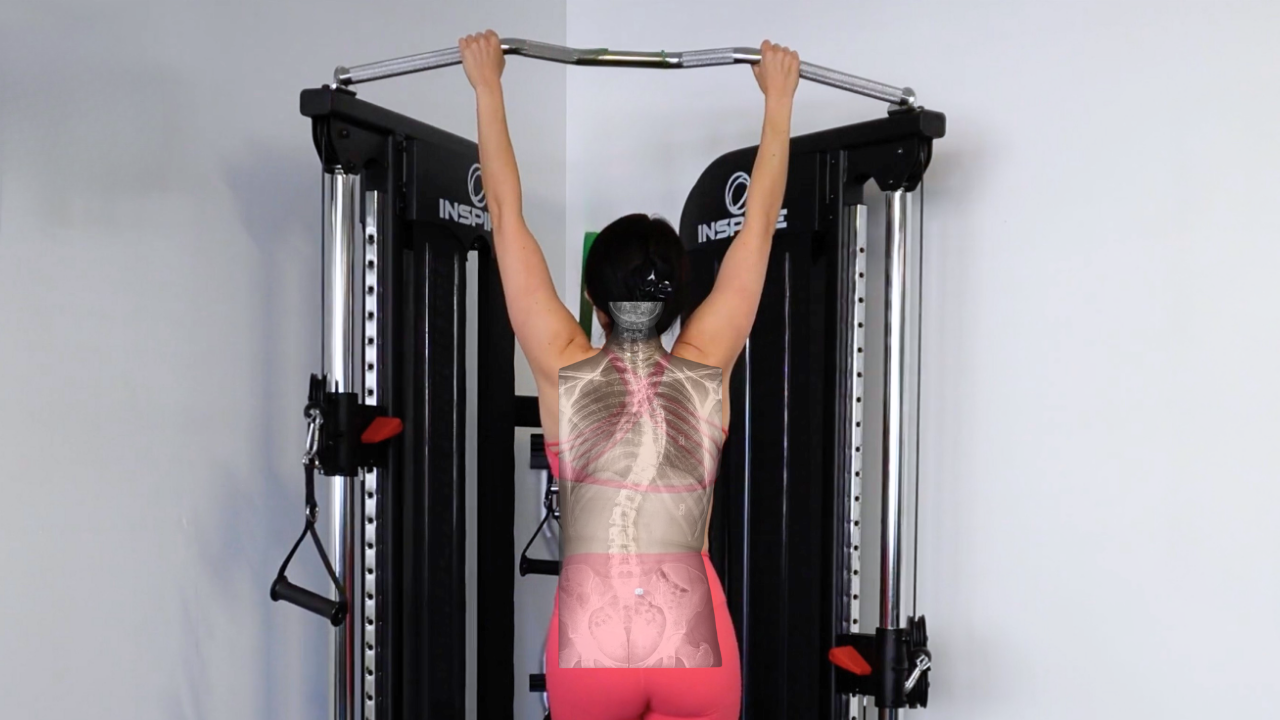
But here's the thing. For those of us with scoliosis, passive stretching, which includes dead hangs and inversion tables, is one of those things that feels helpful in the moment and quietly works against us over time. And once you understand why, you can't unknow it.
So let's talk about it.
Active versus passive stretching: what's actually the difference?
Active stretching is when your muscles are still switched on during the stretch. Your feet are on the ground (what's called a closed-chain position), you're maintaining your neutral spine, and you have control over what's happening from top to bottom. You can direct your breath. You can feel where the stretch is going. You can adjust.
A neutral spine, by the way, doesn't mean a straight spine. It means keeping your natural curves: the cervical lordosis in your neck, the thoracic kyphosis in your upper back, the lumbar lordosis in your lower back. Those curves exist for a reason. They distribute load, absorb shock, and keep your spine functioning well. Active stretching works with them.
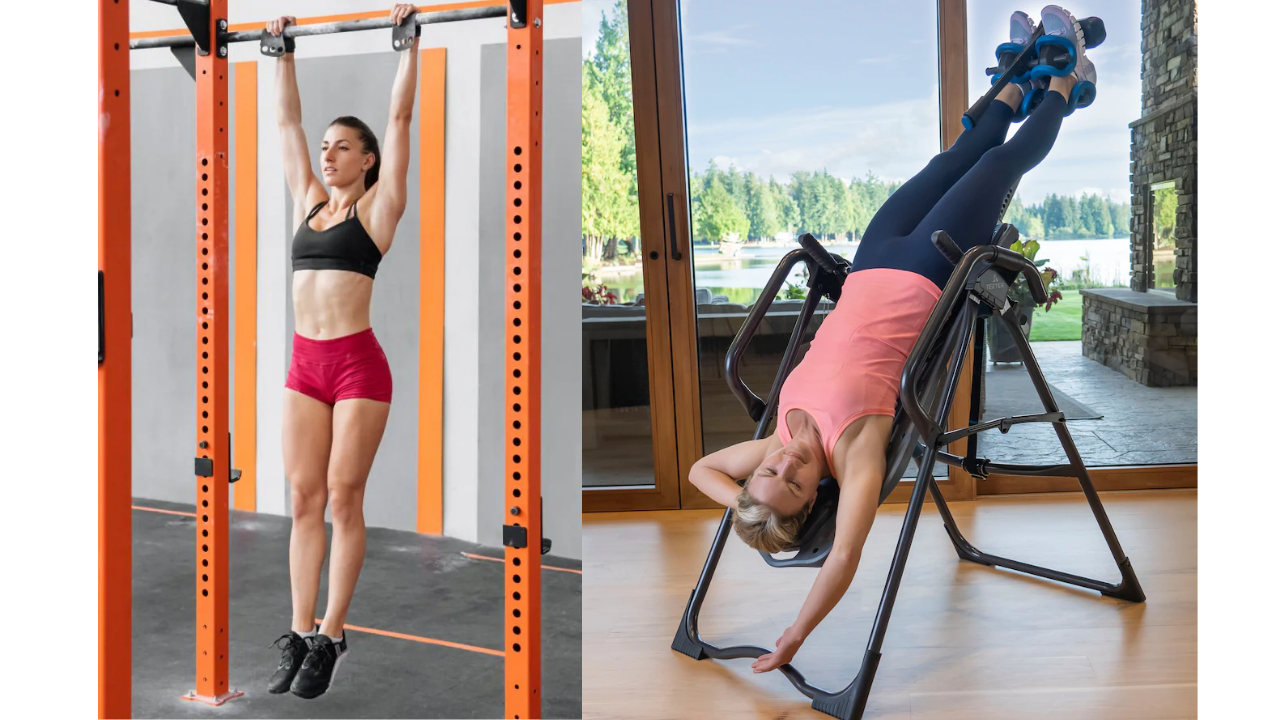
Passive stretching is when the muscles are largely switched off and something external, gravity, a machine, a strap with no engagement behind it, is doing the pulling. Dead hangs. Inversion tables. That limp-noodle feeling of just hanging there. Your body is along for the ride rather than in the driver's seat.
And for a spine without scoliosis, passive stretching is mostly fine. A bit of a blunt instrument, but not harmful.
For a scoliosis spine? It's more complicated.
Why passive stretching doesn't work the way you'd hope for scoliosis
Here's the problem. When you let gravity do all the work without any muscle activation, you lose control over where the elongation actually goes.
Your spine has two sides: the convex side (the bulge, the side that's already over-stretched) and the concave side (the pinched, compressed side that actually needs the work). What we want is to open up the concave spaces. That's where the breath needs to go. That's where the stuck, compressed tissue lives.
But your body, sensibly and annoyingly, takes the path of least resistance. Passive stretching will pull hardest on what's already the most flexible. Which is your convexities. The side that's already over-stretched gets stretched more, while the concave side, the sticky side, barely budges. You end up reinforcing the very asymmetry you're trying to address.
You also lose your neutral spine the moment you go fully passive. Without muscle activation holding you in that natural kyphosis and lordosis, the spine goes wherever the pull takes it. And wherever the pull takes it is usually not where you need it to go.
The Recoil Effect: why coming out of a passive stretch can leave you worse off
This one surprises people. You come out of a dead hang feeling temporarily amazing, then half an hour later your back feels tighter than before you started. Sound familiar?
That's the Recoil Effect.
When you drop suddenly into a deep passive stretch, your nervous system gets a bit alarmed. Your brain's interpretation is: we are being pulled in two. This is not safe. So it fires a protective contraction through the muscles as a safety mechanism. The deeper and more sudden the stretch, the stronger the recoil.
The result is that your muscles contract hard on the way out of the stretch, producing almost the opposite of what you were going for. More tension. Sometimes more pain. Occasionally a worsening of symptoms over time if it becomes a regular habit.
Active stretching avoids this because the muscles never fully switch off. There's no sudden drop into a deep pull, so there's no alarm bell, so there's no recoil. You stay in control the whole time.
What about inversion tables?
I get asked about these a lot, so let's put it to rest.
Inversion tables have the same fundamental problem as dead hangs, just upside down. They're passive. You can't maintain a neutral spine on one. You can't control where the elongation goes. The Recoil Effect applies. And again, your convexities (the over-stretched side) will absorb more of the elongation than your concavities, which is the opposite of helpful.
They feel good. I know. But feeling good in the moment and actually helping your scoliosis are not always the same thing.
So what should you do instead?
Active elongation. Feet on the floor, muscles engaged, neutral spine maintained, breath directed toward the concave spaces. This is the whole foundation of how we approach elongation in ScoliSTRONG, and there are genuinely loads of ways to do it.
Some of my favourites:
The semi-hang. Hands on a bar, feet on the floor, sitting back into an imaginary chair with 90-degree angles at hips, knees, and ankles. You get the decompression of a hang with full control of your spine and breath. You can even add small shoulder shrugs to turn it into a strengthening exercise while you're there.
The forward fold. Hands on a surface at roughly hip height, hinging at the hips, spine long, hips reaching back. A kitchen counter, a desk, a table. You literally have the equipment for this wherever you are.
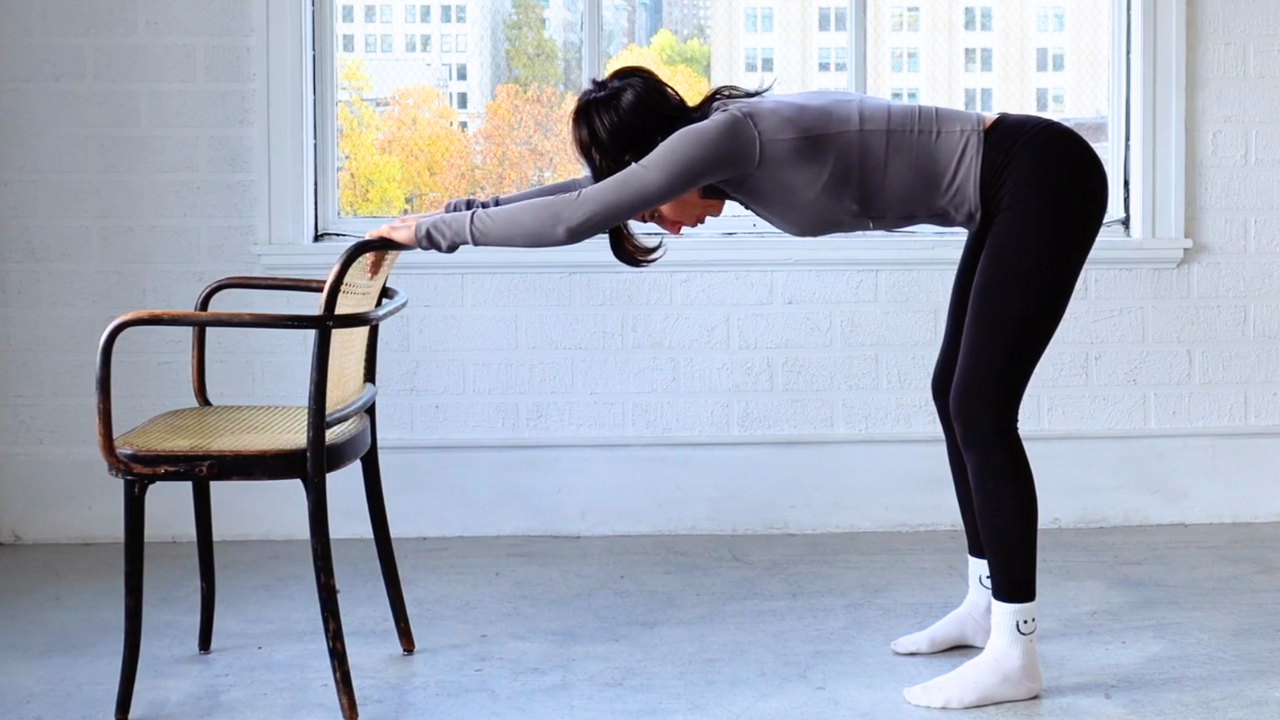
Dowel elongation. A broom handle works perfectly. Push it into the ground, reach through your sit bones, and use it to find maximum lift through the spine. One of the best pre-workout tools we have.
V arms against the wall. Stand facing a wall, reach both arms up in a V shape, press the fingertips into the surface, and breathe. Works anywhere. Takes two minutes. Your spine will feel it.
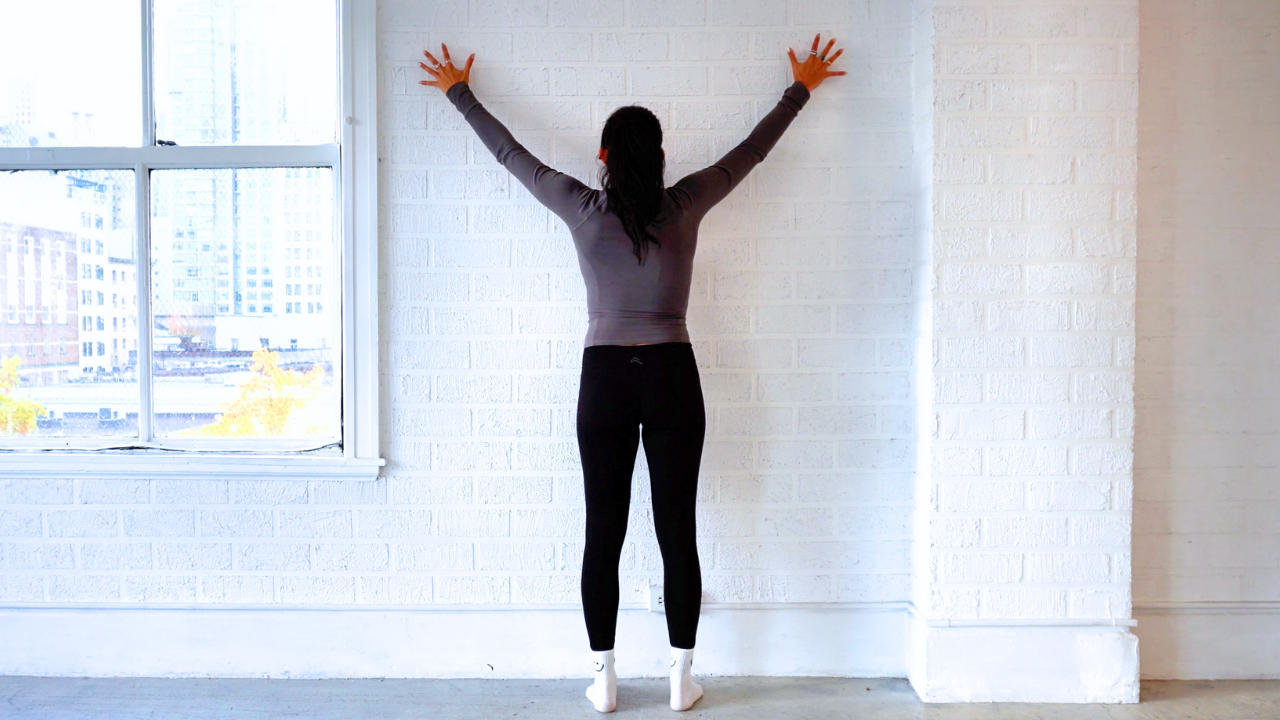
Puppy pose (the scoliosis version). On all fours, hips back halfway, arms reaching forward, spine long and neutral. Different from the yoga version because we keep the thoracic spine neutral rather than going into extension.
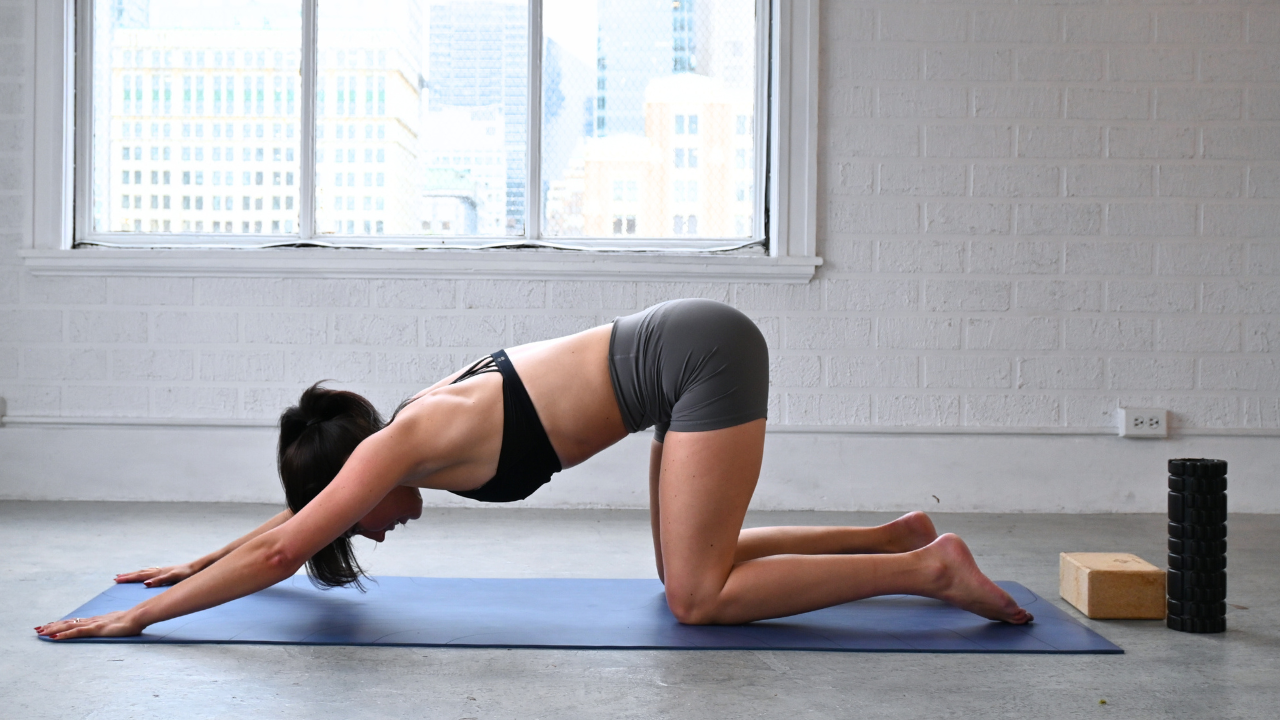
All of these keep your muscles active. All of them maintain your natural curves. All of them let you direct your breath toward the concave spaces that need it. That's active stretching doing its job.
The goal isn't to hang and hope. It's to find length intentionally, breathe into the right places, and build a spine that knows how to hold itself there.
You've got this, curvy friend.
Want to learn more about stretching with scoliosis?
Download the free guide; The Elongation Effect.